
Each region in India has its own culinary narrative that speaks through its distinct dishes. Each cuisine packs within itself, textures, layers, ideas and historical nuggets so that all of Indian food cannot be pigeonholed together to say that there is one Indian cuisine. A fascinating extract from Sonal Ved's Whose Samosa Is It Anyway?.

The outlawed Jamaat-ud-Dawah on Monday described Pakistan's Indus Waters Commissioner Jamaat Ali Shah as an 'Indian agent' after he dismissed the widespread impression that India is 'stealing' Pakistan's share of river waters. Senior JuD leader Abdul Rehman Makki chided Shah and said his statement had weakened the case of 180 million Pakistanis. "He (Shah) is trying to bail out India over the water issue and the people of Pakistan are not convinced," he said.
Here are readers' best photographs from the past year. Share yours too!

'There is a point near the hill where you kill the engine and park your vehicle in neutral.' 'The vehicle automatically slides a few inches, which the locals believe is due to the magnetic power of the hill.'
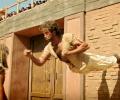
'Ashutosh Gowariker's Mohenjo Daro does what many history books could not have done.' 'He awakens interest in the ancient civilisation of Harapppa and Mohenjo Daro,' says Asim Siddiqui.

These images sent by our readers will ignite wanderlust in you.
'Once accession to Pakistan appeared unlikely, the British instituted Operations Gulmarg and Datta Khel respectively to foil possible accession to India.'
Pakistan's Indus Waters commissioner Jamaat Ali Shah informed the media about the roadmap and said both sides had decided to hold two additional meetings one at the end of March and another in June for "dispute resolution". Both meetings will be in addition to the mandatory one scheduled for May, he said.

The Indian Army has shown it can face down the PLA, but is too often held back by a political leadership that lacks boldness, asserts Ajai Shukla.
The alleged 'water blockade' by India could adversely affect kharif crops, particularly cotton and sugarcane that are in maturity stage and require final watering, and the sowing of rabi crops early next month, sources told the Dawn newspaper.

'It was the Mughals who first established standard units of measurement and maintained offices of meticulous record keepers and auditors, departing from the more haphazard methods of earlier regimes.' 'By the end of the 16th century, their revenue and judicial administrations exhibited an obsessive preoccupation with order, the efficient management of time, and a spirit of rational self-control -- all of them characteristics of early modernity,' point out Sheldon Pollock and Benjamin Ellman.
According to the provisions of the treaty, the decision of Professor Lafitte on all matters within his competence is final and binding.
Water Resources Minister Saifuddin Soz emphasised that river Jhelum, on which the project is proposed to be built, is a 'symbol of our civilisation' and cannot lose the right of navigation on it.
Pakistan had earlier moved the World Bank for appointment of neutral experts but India has insisted on solving the issue bilaterally.
"The design of the project is strictly according to the Indo-Pak water treaty and will not become hurdle in the peace process," Union Water Resources Minister Priya Ranjan Dasmunshi explained.

'Many fresh faces have come before him on both sides, and every sort of individual -- liberal, conservative, hardliner, dictator -- has come and gone.' 'I think we just seem to be happier when we hate one another,' says Aakar Patel.
The experts said that climate change is not only raising temperatures and making India's heatwaves hotter, but also changing weather patterns that further drive dangerous weather extremes.
Pakistan claims the project violates the 1960 Indus Water Treaty.

Twenty-two British and French trekkers, stranded in high altitude Ladakh region of Jammu and Kashmir following heavy downpour, have been rescued by Indian Air Force personnel in the past two days.
According to Pakistan, India will violate the Indus Water Treaty by constructing a hydropower project on Chenab.
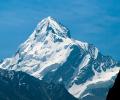
'Glaciers are melting all across the region.'

'The lush green of Kashmir was exactly like the postcards and posters I had seen growing up.'

The Sindhis are a lesson in perseverance. Once uprooted, they've started all over, often reinventing themselves

At a time when China is trying to make its foray into South Asia, India should use its shared history to strengthen its ties in the region, says Dr Rup Narayan Das.
A realistic assessment will tell us that not much has changed between India and Pakistan; the relationship remains as fraught as before with little prospect of reconciliation, notes Ajai Shukla.

'The Dancing Girl is only one of the many symbols they threaten today.' 'Our country is changing.' 'Elements that ought to have remained on the fringes have been handed power and control of a state on a platter.' 'With this, the party that persistently wooed us with its development agenda has arrogantly taken its mask off,' says Veenu Sandhu.

Lauding the bravery displayed by the soldiers, the prime minister said: "The bravery that you and your compatriots showed, a message has gone to the world about India's strength."
'The logical step is to challenge the very legitimacy of the Chinese claim over Tibet,' recommends Inspector General Gurdip Singh Uban (retd).

The aftermath of Mani Ratnam's Ponniyin Selvan has led to an argument that there was no religion as Hinduism in Chola times.
Instead, there was only Saivism, Vaishnavism, etc, and that the Cholas were Saivites, and hence not Hindus, observes N Sathiya Moorthy.

Looking for travel inspiration as you plan your summer vacation? Here's help.

Through the past 18-month period, peace has prevailed in the disputed border regions, which was immensely helpful in the difficult situation that the country was passing through, observes Ambassador M K Bhadrakumar.

India's failure to resolve the Kashmir issue and improve relationship with Pakistan has been an "impediment" to India's rise and become the greatest hurdle in it becoming a permanent member of the UN Security Council and the Nuclear Suppliers Group, Pakistan Prime Minister Nawaz Sharif's envoys have claimed.
'If we had sent a few airplanes (into Tibet), we could have wiped the Chinese out.' 'And everything could have been different in the 1962 War.' 'They did not believe me there was no Chinese air force.' 'Can you imagine what would have happened if we had used the IAF at that time?' 'The Chinese would have never dared do anything down the line.'

'The missile mounted near Kailash-Mansarovar is called DF-21. It is a medium-range, 2,200 kilometres ballistic missile. Its advantage is that it can cover all cities of north India, including New Delhi'

Pakistan perceives that if it had declared Gilgit-Baltistan, PoK or both, which are only a part of the territories of J&K, as legitimate provinces of Pakistan it would weaken its case for the entire J&K and lead to legal complications, observes Lieutenant General Syed Ata Hasnain (retd).
Social activist Niranjan Bhatwal from Maharashtra has moved a Public Interest Litigation in the Supreme Court seeking that the country be called 'Bharat', and not 'India' as the latter is of colonial origin, and that the constitution makers intended that 'Bharat' be used for all official and unofficial purposes, and not 'India'.

'All the government needs to do is to identify clear political and strategic objectives and to give the military planners a free hand,' asserts Ajai Shukla.

Major General Sujan Singh Uban, a legendary veteran of the Second World War, was a natural choice to raise, train and command the Special Frontier Force and mould them into a well oiled fighting machine, recalls his son Inspector General Gurdip Singh Uban (retd), who led SFF troops during the Kargil War.

'Above 2,000 metres the gradient of the Himalayas is very steep and if you build any infrastructure (roads, dams, hydro power projects) in these regions, it will not be able to sustain these events (the onslaught of debris that comes down with great speeds).'

An eight-member Pakistani judicial commission team crossed into India from the Wagah border check post in Punjab on Saturday to conduct the much-delayed cross-examination of witnesses in the 2008 Mumbai attacks, which claimed 166 lives.
